

How to Choose a Smart PDU? What Factors Should You Consider?
Release Date:
2025-07-16
How to Choose a Smart PDU? What Factors Should You Consider?
An Intelligent PDU (or Smart PDU) does more than simply distribute power to IT equipment in data centers; it can monitor, manage, and control the power consumption of multiple devices.

There are two types of power distribution units (PDUs): basic and smart. While both can provide reliable power distribution to critical IT equipment within racks or cabinets, smart PDUs offer a range of intelligent features that help data center managers gain visibility into their power infrastructure. As data centers become increasingly dynamic and complex, the adoption of smart PDUs is also on the rise.
What is an intelligent PDU?
An Intelligent PDU (or Smart PDU) does more than simply distribute power to IT equipment in data centers. It can monitor, manage, and control the power consumption of multiple devices. By providing data center professionals with remote network access to real-time critical infrastructure data, intelligent PDUs enable informed decision-making, helping to maximize availability and meet key efficiency objectives.
Although there are two main types of smart PDUs—monitoring-type and switching-type—each type offers a variety of additional features that can be incorporated to enhance the critical information obtained from connected equipment. Key features include outlet-level monitoring, environmental monitoring, alerts based on user-defined thresholds, and other alarm functions.
As data center environments become increasingly dynamic and complex, many organizations are pressing data center managers to enhance availability while reducing costs and improving efficiency. Next-generation high-density servers and networking equipment are driving greater demand for higher rack densities and more robust facility power supplies.
While densities below 10 kW per rack remain the norm, 15 kW deployments are now commonplace in hyperscale facilities—some even approaching 25 kW. High-density configurations deliver superior performance and capacity, but they demand more efficient power delivery. Consequently, the features and capabilities available in intelligent PDUs are becoming increasingly critical for enabling efficient power distribution that can adapt to changes in data center capacity and density.
Types of Intelligent PDUs
Intelligent PDUs can be further categorized into monitored and switched types. At their core, PDUs provide reliable power distribution; more intelligent models, however, incorporate remote monitoring capabilities, energy management features, and a future-proof design platform.
Monitoring PDU
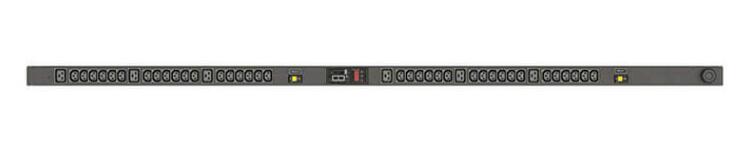
Monitored PDUs provide a comprehensive view of power usage both on the rack and via remote access, while continuing to deliver reliable power distribution to critical IT equipment. Monitoring PDUs are available with remote monitoring options at the unit level and at the outlet level, offering a more granular view of power consumption down to the individual device level. They enable rapid access to key metrics for assessing energy-use trends and include alerting capabilities to notify users when predefined power thresholds are breached. Consequently, this type of PDU is recommended for data centers seeking to monitor power usage or improve Power Usage Effectiveness (PUE).
Switch-type PDU

Switched PDU solutions provide a comprehensive view of power usage for critical IT equipment—both at the rack level and via remote access—and enable remote control to turn individual outlets on, off, or reboot them. Switched PDUs also offer configurable remote monitoring at both the unit and outlet levels. They are ideally suited for data centers that need to cap outlet-level power consumption to prevent accidental overloads, as well as for remote data centers. Additionally, they are highly beneficial for data centers that require quick and straightforward power cycling for devices across large facilities—or, in some cases, across an entire facility network.
Common Features of Smart PDUs
Key features should be considered when making a selection.
IP aggregation—combining IP addresses and switch ports—is becoming increasingly costly; therefore, data center managers can reduce the total cost of deploying intelligent PDUs by using units that support IP aggregation. When evaluating deployment costs, it is crucial to examine the manufacturer’s limitations, as the number of devices that can be aggregated under a single IP address ranges from 2 to 50. Additional features, such as downstream device self-configuration for IP aggregation, can also significantly shorten deployment time and lower costs.
IT equipment used for environmental monitoring is susceptible to environmental conditions such as high temperature and humidity. An intelligent PDU can integrate with environmental sensors to proactively monitor the environmental conditions within the rack, ensuring optimal operating conditions without the need to deploy a separate monitoring solution.
Remote Connection
Smart PDUs also enable data center managers to remotely access the PDU via network interfaces or serial connections to monitor power consumption and configure user-defined alarm notifications, thereby helping to prevent downtime.
Out-of-band communication: When the primary network of a PDU fails, some PDUs provide redundant communication by integrating with out-of-band management devices, such as serial consoles or KVM switches.
The DCIM market offers a wide range of DCIM solutions that provide users with a single access point for viewing real-time power and environmental data. DCIM also enables the creation and delivery of trend reports, which offer end-to-end visibility across the entire facility, helping data center managers improve efficiency and availability.
Key Considerations When Selecting an Intelligent PDU
Smart PDUs provide precise energy consumption monitoring and control. They enable data center managers to optimize the sizing of power infrastructure and eliminate unnecessary expenditures. When selecting smart PDUs, other key considerations include their ability to ensure reliability, functionality, and adaptability.
The core functions of an intelligent PDU with advanced reliability features should not be compromised or hindered. Whether you choose a basic PDU or an intelligent PDU, it is crucial to purchase from a manufacturer that prioritizes quality and reliability. Not all manufacturers conduct 100% testing on every unit leaving their facility. It is advisable to select a manufacturer that not only tests each individual unit but also spares no effort throughout the product development process to rigorously verify the reliability of the unit’s core functions.
High-temperature grade
Efficiency initiatives by enterprises have led data centers to raise thermostat settings in order to reduce energy consumption. As a result, facility temperatures in data centers are increasing. This shift necessitates that manufacturers design PDUs to operate at higher temperatures. Depending on the manufacturer, the maximum operating temperature range for PDUs typically spans from 45°C to 65°C. In high-temperature environments, it is advisable to use high-temperature-rated PDUs to ensure reliable power distribution and system availability.
Alternating outlet
As rack density increases, cable management and load balancing become increasingly challenging. If the load is not properly balanced across circuits and phases, data center operators risk circuit overloads and other issues. To simplify circuit/phase balancing and cable management, PDU manufacturers offer color-coded alternating outlets, which can significantly streamline the deployment process.
Locking socket
The socket-locking mechanism ensures a secure physical connection between IT equipment and the PDU, preventing power cords from being inadvertently disconnected and thereby avoiding unexpected load drops. Globally, the most commonly used socket standards for PDUs are IEC 320 C13 and C19. IEC sockets are internationally recognized and can accommodate output voltages of up to 250 V.
Intelligent PDUs can measure, manage, and report data center equipment’s energy consumption in real time. With granular metering and advanced management controls, data center managers can optimize energy use and more easily accommodate changes in equipment and capacity. Moreover, by gaining visibility into the power draw of each IT device, they can demonstrate the business case for investing in technology upgrades.
By deploying intelligent PDUs, data center managers can remotely schedule power cycling for idle IT equipment to reduce energy consumption. They can right-size the power infrastructure to eliminate unnecessary capital expenditures, obtain refunds based on actual energy usage, and proactively manage consumption to enhance efficiency.
Smart PDUs can proactively alert users to impending issues before they occur. When predefined warning or critical thresholds are breached, the system promptly notifies users so they can address critical problems—such as an overload condition—before it causes circuit breakers to trip and disconnects the connected loads. All alerts are delivered in standardized formats, including SMS, SNMP traps, or email. Moreover, smart PDUs can be integrated with centralized management software, making them easy to administer.
Flexibility at the rack level is a critical enabler for data centers to adapt to evolving needs, often requiring higher density as well as greater efficiency and control.
The future-oriented design of smart PDUs departs from the conventional approach of oversized infrastructure systems, which are inefficient in terms of capital and energy costs. Data center managers equipped with both basic and smart PDUs that support scalability can easily upgrade their hot-swappable monitoring devices to leverage new technologies and adapt to evolving business needs—without having to replace the entire distribution panel or interrupt power to critical servers.
PDU Services
Some vendors pre-install PDUs in racks to reduce deployment time and on-site installation costs. Before ordering racks and PDUs, work with a vendor partner who can assess your PDU requirements to optimize the availability and capacity of your entire power distribution chain.
To optimize IT resources, enterprises can leverage services offered by PDU original equipment manufacturers (OEMs) to streamline the deployment and management of critical power-system assets.
OEM service partners can handle PDU installation and commissioning. While IT staff can focus on other tasks, enterprises benefit from the convenience and assurance of having OEM experts properly manage the setup from the outset. These technicians can also handle the removal and disposal of legacy PDUs.
Some OEMs offer protection plans lasting up to five years to support the PDU lifecycle. They also provide on-demand access to service history and comprehensive reporting, which helps streamline PDU management under contract. In addition, 24x7 on-site emergency response services are available to ensure maximum availability of critical applications.
Summary
Intelligent PDUs are strategic assets that ensure high availability in data centers, providing the most comprehensive visibility into IT power consumption within the rack. They also enable intelligent power monitoring across the data center and must be flexible and adaptable to accommodate rapid changes. Enterprises should prioritize reliable intelligent PDUs that offer a broad range of features and can meet both current and future requirements. Furthermore, they should leverage OEM-provided PDU services to reduce deployment time and costs.
PDU,Data Center Power Distribution,Intelligent Busbar,Data Center,IDC data center
Related News
Exploring the Future Development and Applications of Busbar Trunking Systems
This article explains the importance of busbar trunking systems in modern power systems and their future development trends.
2026-04-10

Hello, how may we assist you?
*Note: Please ensure all information is accurate; we will contact you as soon as possible.
SAF Coolest v1.3.1.1 设置面板 JYOSD-ZUEU-XXZSE-SZV
无数据提示
Sorry, this section is currently being updated. Please stay tuned!
You can view other sections or return.Home